Inside the formula · 1%
Sesame Oil
A seed small enough to disappear between two fingers has traveled through cuisines, cultures, and centuries. In Neuroleva, Sesame Oil arrives in the smallest proportion—and leaves one of the most intentional signatures.
The beginning
The seed that crossed the ancient world
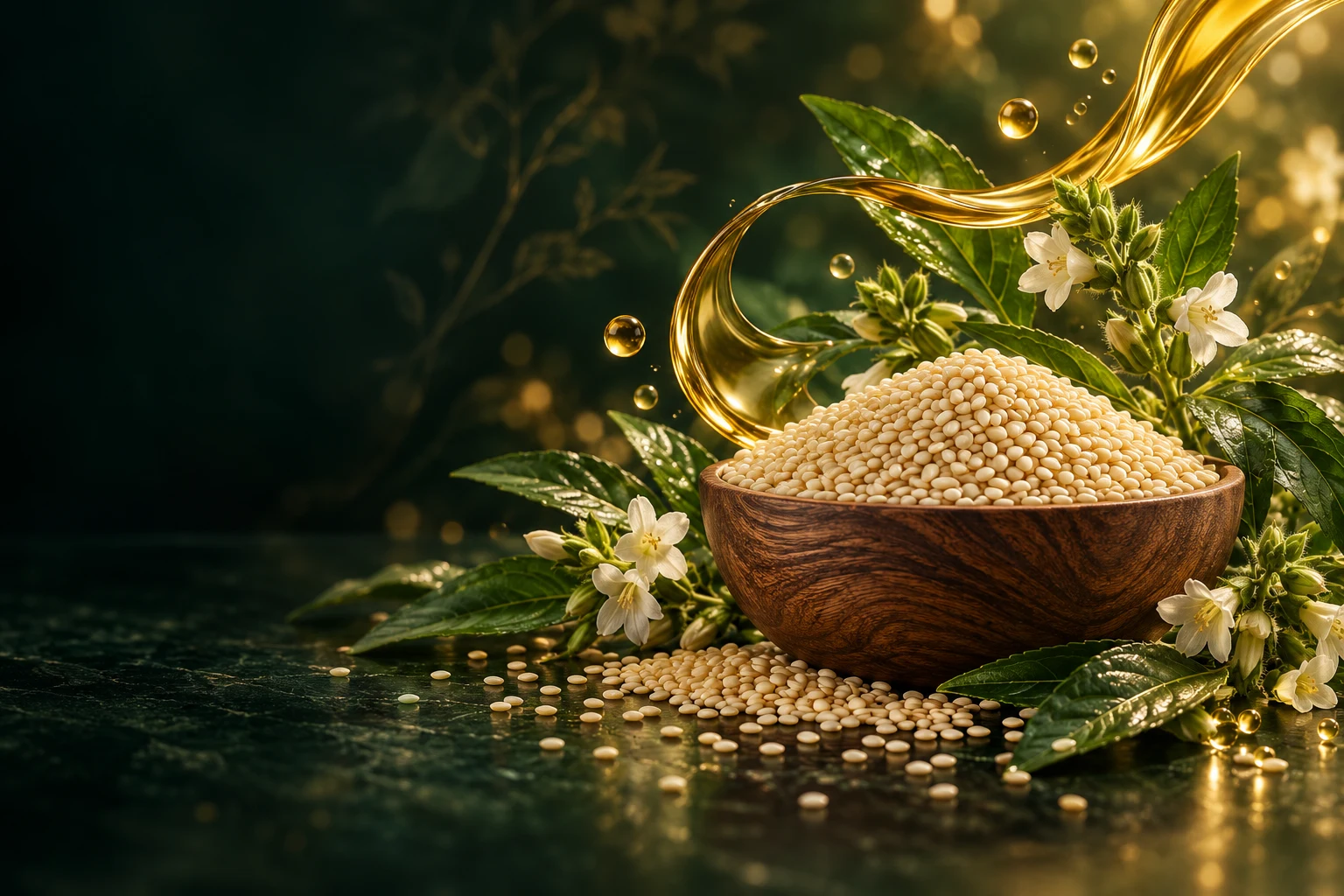
Sesame is among humanity’s oldest cultivated oilseed crops. Long before global trade had its modern name, these tiny seeds moved through Africa, Asia, the Middle East, and the Indian subcontinent—carried because something so small held remarkable richness within it.
The seed entered breads, pastes, sweets, kitchens, remedies, and family traditions. Pressed into oil, it revealed a warm botanical character and an unusual natural stability that helped it endure far beyond the harvest.
Its history earned attention. Its composition earned a place in Neuroleva.
Perhaps that is why sesame became surrounded by stories of hidden abundance. The seed looks modest until it is opened, crushed, or pressed; only then does its richness reveal itself. Across cultures, sesame came to symbolize the discovery of value concealed inside something almost weightless.
Small enough to overlook.
Rich enough to travel for thousands of years.
Inside the oil
Where the seed keeps its signature
Sesame Oil is naturally rich in unsaturated fats, with oleic and linoleic acids forming much of its fatty-acid profile. Yet its most recognizable fingerprint lies in a family of plant compounds with names almost as distinctive as the seed itself: sesamin, sesamolin, and sesamol.
These lignans appear alongside tocopherols and phytosterols in the oil’s smaller, biologically interesting fraction. Together they have made Sesame Oil a continuing subject of research into oxidative stability, metabolism, and the ways plant compounds interact with the body.
The minerals associated with whole sesame seeds largely belong to the seed, not the purified oil. Neuroleva does not need to borrow qualities the oil does not possess. Its real composition is compelling enough.
Sesamin and sesamolin are not decorative names added to make the story sound scientific. They are part of the oil’s genuine chemical signature—compounds that help distinguish sesame from coconut, olive, and the many other plants capable of producing oil. They are the molecular handwriting of the seed.
The enduring oil
A natural lesson in resilience
Oils are delicate. Light, heat, and time can change them. Sesame Oil has long been admired for holding its character with unusual confidence—a quality connected in part to its natural lignans and tocopherols.
That resilience gives the oil a fitting symbolic role in a formula built around daily consistency. Its value begins with what is already present: unsaturated fats, distinctive lignans, and a botanical identity no other oil can imitate. Those qualities continue to inspire research across metabolic and neural health.
In a world of exaggerated ingredient lists, sesame reminds us that distinction does not require volume.
Its stability also offers a beautiful metaphor for consistency. Sesame does not need to dominate the composition to influence its character. It contributes through persistence: the ability to remain recognizable, to carry its own identity, and to make a measured presence feel more lasting than its size would suggest.
Resilience in the seed.
Character in the oil.
Precision in the final drop.
The human story
Tradition that continues to invite discovery
Across the regions where sesame became part of daily food, it was valued not because people could list every molecule, but because generation after generation found a place for it at the table.
Today, researchers examine Sesame Oil’s lignans, unsaturated-fat profile, antioxidant behavior, and possible roles in metabolic and neural health. Much of that story is still being written, especially in humans—and that makes honesty part of the luxury.
Neuroleva celebrates the ingredient without asking it to pretend. Sesame Oil brings exactly what belongs to it: an ancient lineage, a sophisticated natural chemistry, and a finishing character entirely its own.
That balance between reverence and curiosity is where the modern sesame story belongs. We can honor the kitchens and traditions that carried the oil forward while allowing contemporary research to examine its lignans, fatty-acid profile, and interactions with human biology. The past gives the ingredient meaning; inquiry gives the story new horizons.
Its place in Neuroleva
Why one percent can complete the whole
Neuroleva does not contain Sesame Oil to make the label longer. And its proportion was not enlarged merely to make the ingredient sound more important. Its place is 1%. Deliberately.
MCT Oil forms the foundation. Extra Virgin Olive Oil brings the Mediterranean heart. Sesame Oil arrives last—not as an afterthought, but as the finishing signature that closes the composition.
Perfumers understand this instinctively: the final note may be the smallest, yet it can change the memory of the entire blend. Neuroleva applies the same discipline to proportion. Nothing is asked to be louder than its purpose.
One percent is therefore not an apology for scarcity. It is a statement of control. It says that the formula was not built by making every ingredient equally large, but by deciding where each one becomes most expressive. Sesame enters at the edge of perception and leaves the composition with a signature it did not have before.
Not everything important needs to be abundant.
Some ingredients are powerful because their place is exact.
The formula
1% · The Finishing Signature
One percent. An ancient signature. The final note that completes Neuroleva.